September 28, 2026
How Dirty Solar Panels Shrink Your PG&E Savings in the Greater Sacramento Area
You installed solar panels to slash your electricity bills. But if a layer of dust, pollen, and grime is building up on those panels, you're probably losing more money every month than you realize.
Solar soiling—the technical term for dirt accumulation on photovoltaic surfaces—doesn't just reduce energy production. It directly hits your wallet through lower PG&E credits, higher grid purchases, and missed savings that compound over time. For Sacramento homeowners already navigating rising electricity rates and new billing structures, understanding the connection between panel cleanliness and actual dollar losses isn't just interesting. It's financially essential.
This guide breaks down exactly how dirty solar panels affect your PG&E bill, translates those efficiency losses into real numbers, and shows you why professional solar panel cleaning in Sacramento might be one of the smartest home maintenance investments you make this year.
What Solar Soiling Actually Costs Sacramento Homeowners
The National Renewable Energy Laboratory (NREL) has extensively studied how dirt, dust, pollen, bird droppings, and other debris affect solar panel performance. Their research shows that soiling typically causes annual energy losses of around 5% for residential systems in climates similar to Sacramento's [1]. Some studies have documented efficiency drops of 6.5% or more within just a few months without cleaning, depending on local conditions.
But what does 5% actually mean for your household budget?
Consider a typical Sacramento-area home with a 7 kW solar system. Under normal conditions, that system might generate around 10,000–12,000 kWh annually. A 5% production loss translates to roughly 500–600 kWh of electricity you're no longer producing each year.
With PG&E's current residential rates averaging around $0.35–$0.45 per kWh depending on your rate plan and tier, that soiling loss can represent $175–$270 in reduced annual value from your solar investment [3]. For larger systems or homes with higher energy consumption, the losses climb proportionally.
Spread that across the 25–30 year lifespan of your panels, and the cumulative cost of neglected maintenance becomes substantial.
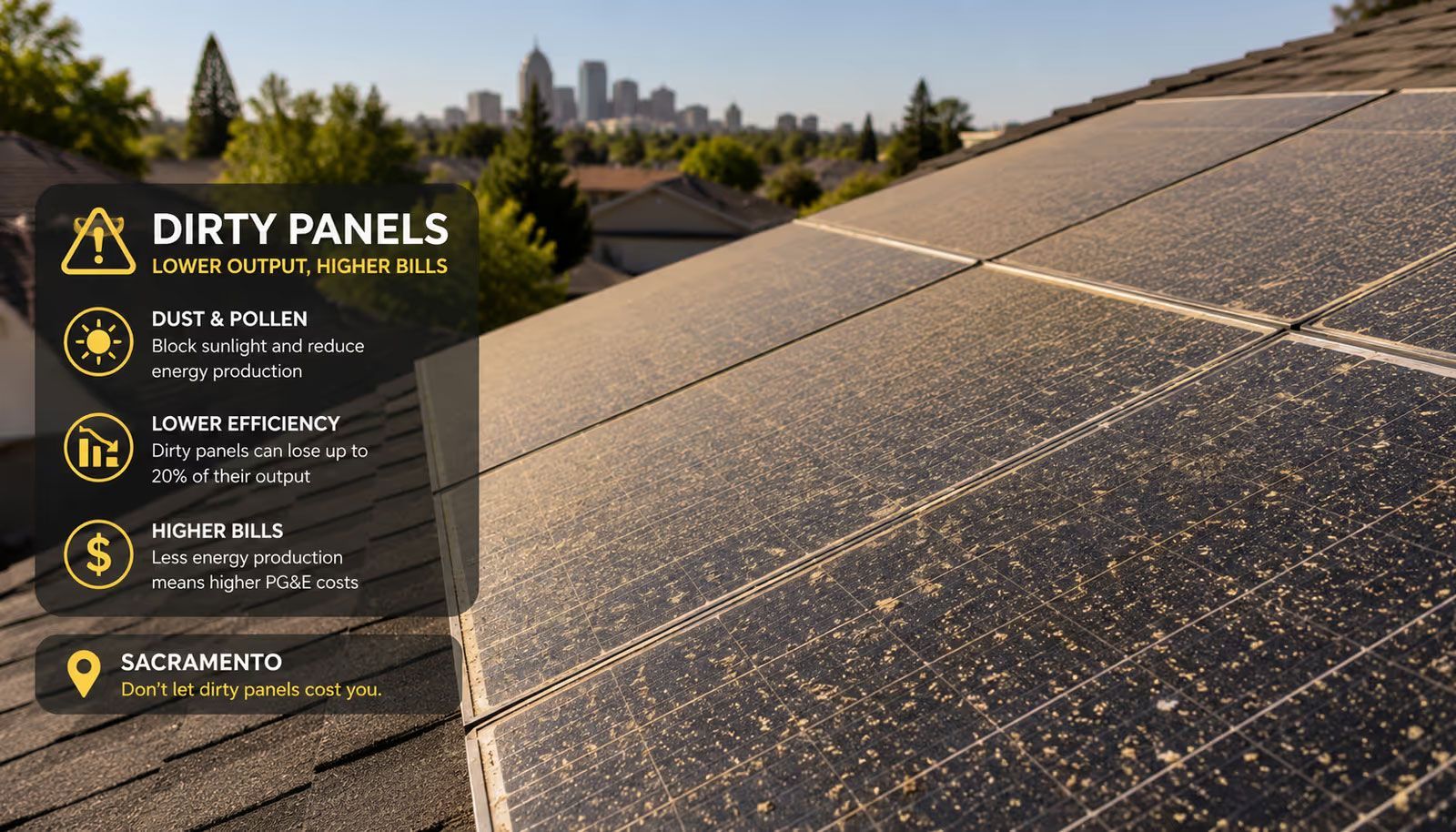
Solar panel soiling reduces Sacramento homeowners' PG&E savings by hundreds annually
How Soiling Losses Show Up on Your PG&E Bill
Understanding how dirty panels translate to higher bills requires a quick look at how solar billing actually works.When your panels produce electricity, you either use it immediately or send excess power back to the grid in exchange for credits. At the end of your billing period, PG&E calculates the difference between what you consumed and what you generated. Ideally, solar homeowners aim for a near-zero or small true-up balance.Soiling creates problems at multiple points in this equation:
- Reduced daytime generation means you're pulling more electricity from the grid during peak hours—exactly when rates are highest under time-of-use billing. Instead of powering your air conditioning with free solar energy on a hot Sacramento afternoon, you're buying expensive peak-rate electricity.
- Fewer export credits accumulate because your dirty panels aren't producing enough surplus power to bank for later use. Those credits offset your evening and nighttime consumption when your panels aren't generating anything.
- Higher true-up bills result when the math doesn't balance at year-end. Many Sacramento homeowners who expect minimal annual payments find themselves surprised by charges that seem disconnected from their original solar projections.
Most people blame their panels, their system design, or PG&E rate increases—never considering that a simple cleaning could restore much of their expected performance.
NEM 3.0 Changes Make Panel Efficiency More Important Than Ever
If you installed solar under California's earlier Net Energy Metering programs, you locked in relatively favorable rates for excess power you export to the grid. But the solar landscape has shifted significantly with NEM 3.0, which took effect in April 2023 [4].Under the new structure, export credits have dropped substantially compared to previous programs. Homeowners now receive roughly 75–80% less for the electricity they send back to PG&E than they did under NEM 2.0 [5]. It's worth noting that exact export rates vary based on time of day under California's time-of-use structure, but the overall reduction is significant across all periods.What does this mean for panel cleanliness?
- Self-consumption becomes critical. Since export credits are worth less, maximizing the power you use directly matters more than ever. Every kilowatt-hour lost to soiling is energy you'll need to purchase at full retail rates instead of generating for free.
- System efficiency directly impacts ROI. With tighter margins on solar economics under NEM 3.0, maintaining optimal panel performance isn't optional—it's the difference between a system that pays for itself on schedule and one that underperforms projections.
- Battery storage amplifies losses. If you've paired your panels with battery backup (increasingly common in Sacramento), soiling reduces the power available to charge your batteries. During outages or evening peak hours, you'll have less stored energy to draw from.
For homeowners who installed solar more recently under NEM 3.0 rules, the financial case for keeping panels clean is actually stronger than it was for earlier adopters.
Why Sacramento's Climate Creates Unique Soiling Challenges
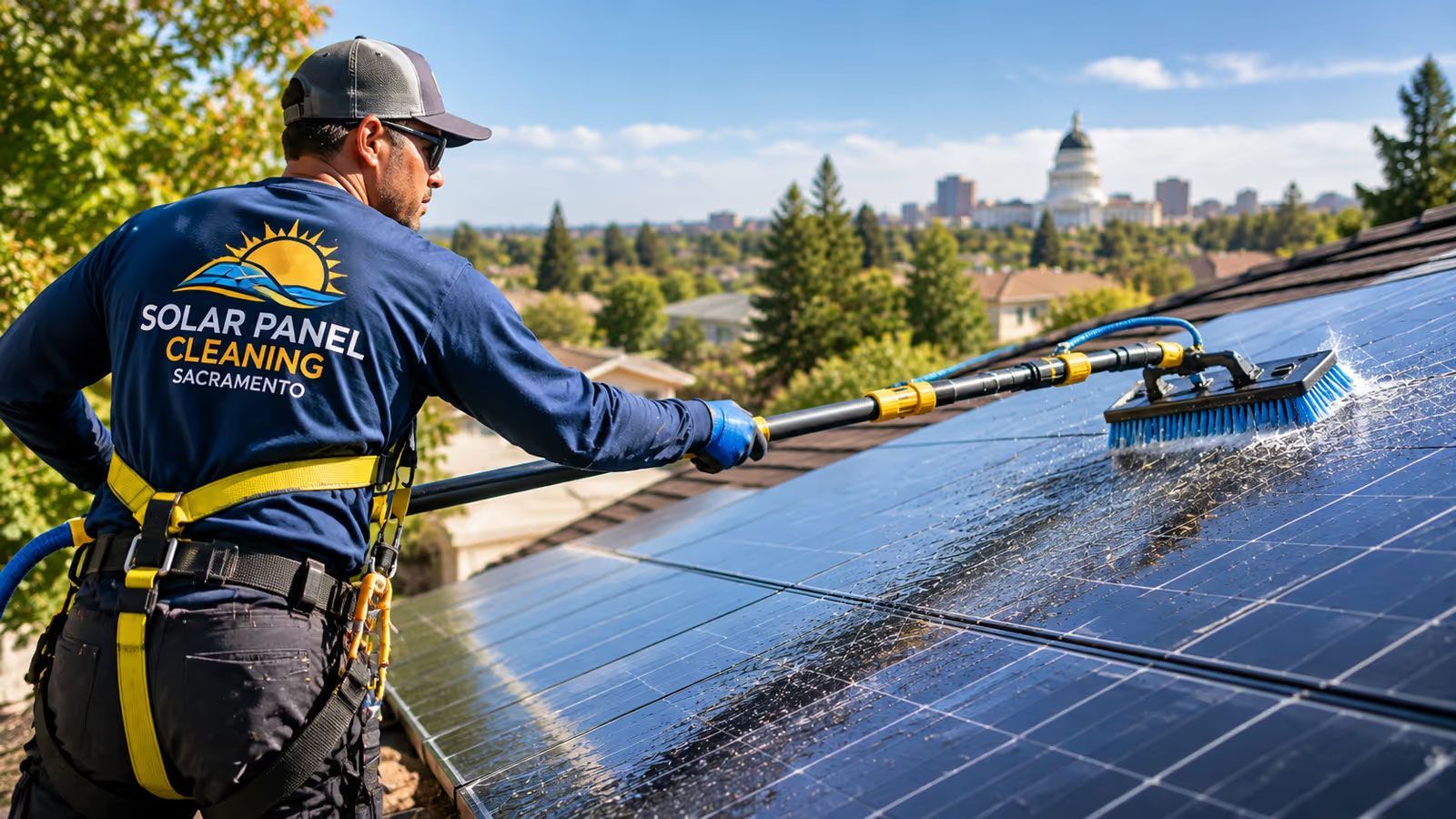
Professional solar panel cleaning in Sacramento restores efficiency using specialized equipment
Greater Sacramento presents a particular combination of factors that accelerate solar panel soiling. Anyone who's watched the Delta breeze blow Central Valley dust across the region understands why outdoor surfaces here don't stay clean for long.
- Agricultural dust from the surrounding Central Valley settles consistently across the region. Elk Grove, Natomas, and areas near farming operations see especially heavy accumulation during dry months.
- Pollen seasons in spring bring waves of tree and grass pollen that coat outdoor surfaces—including your roof. Oak, walnut, and grass pollens create sticky films that don't simply rinse away with light rain.
- Wildfire smoke has become an unfortunate summer reality. Ash and particulates from fires deposit on panels and can actually bake onto glass surfaces during extreme heat, requiring more than a simple rinse to remove.
- Bird activity varies by neighborhood, but many Sacramento communities with mature trees see significant droppings. A single bird dropping can shade enough cells to impact production on an entire panel string.
- Construction dust affects rapidly developing areas like Roseville, Rocklin, Lincoln, and Folsom, where nearby building activity sends fine particles into the air.
- Minimal summer rainfall means nature won't clean your panels for you during the months when production matters most. Sacramento's Mediterranean climate leaves panels essentially unwashed from May through October—exactly when solar generation potential peaks.
These local conditions mean Sacramento-area homeowners often experience soiling losses at the higher end of national averages, making maintenance particularly valuable.
What Professional Solar Panel Cleaning in Sacramento Actually Involves
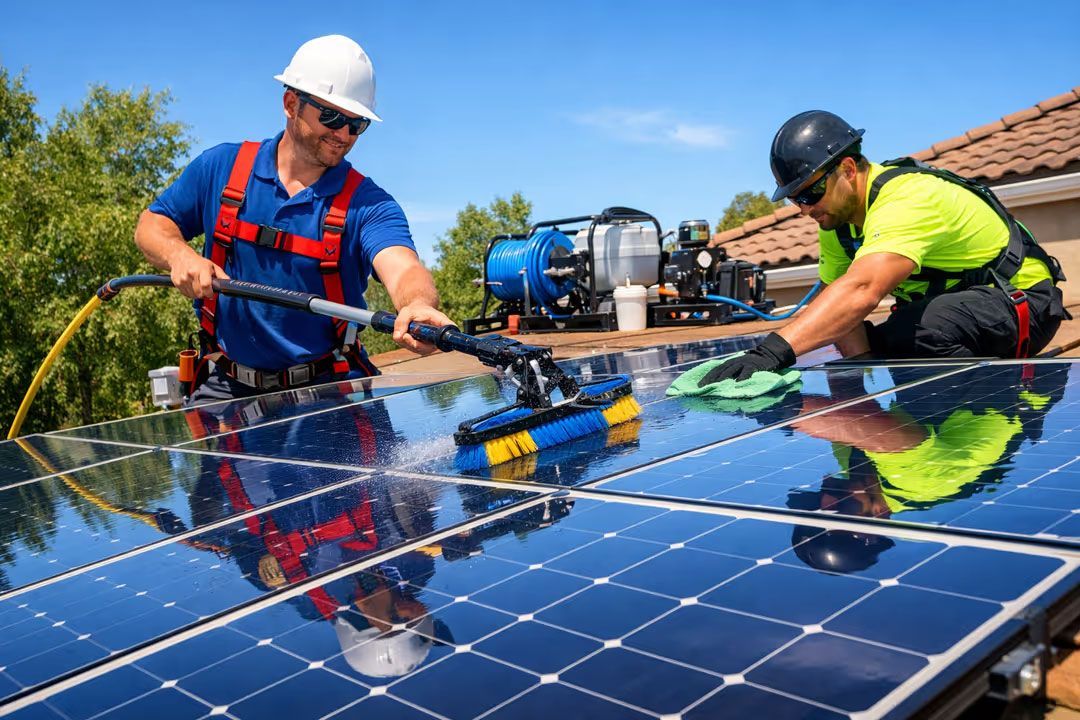
Understanding what you're paying for helps explain why professional cleaning outperforms DIY attempts.Trained crews use specialized equipment designed specifically for solar panel surfaces:
- Deionized or purified water prevents mineral deposits that tap water leaves behind as it evaporates. Sacramento's water contains minerals that can actually make panels dirtier over time if you're using untreated water from your garden hose.
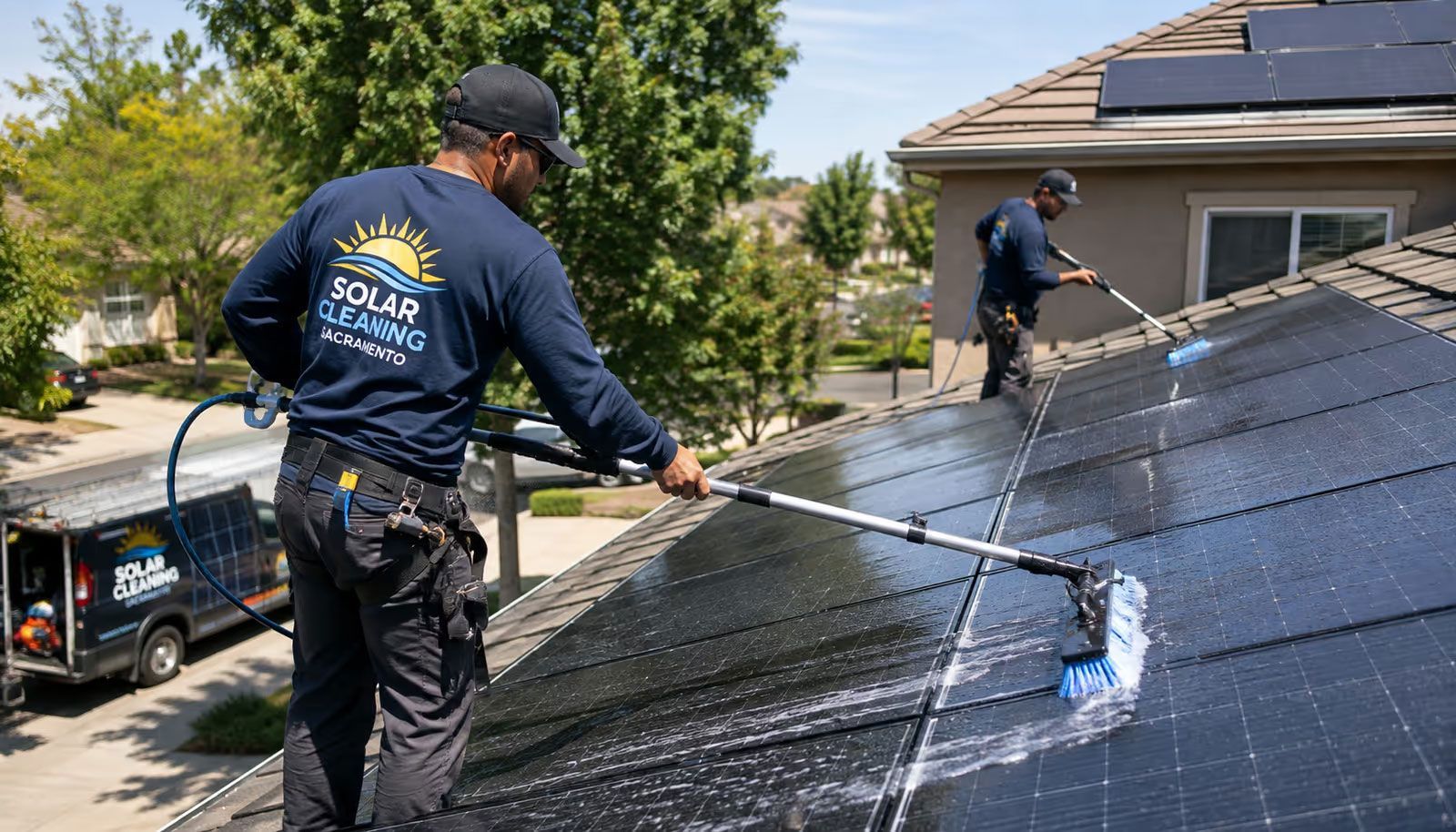
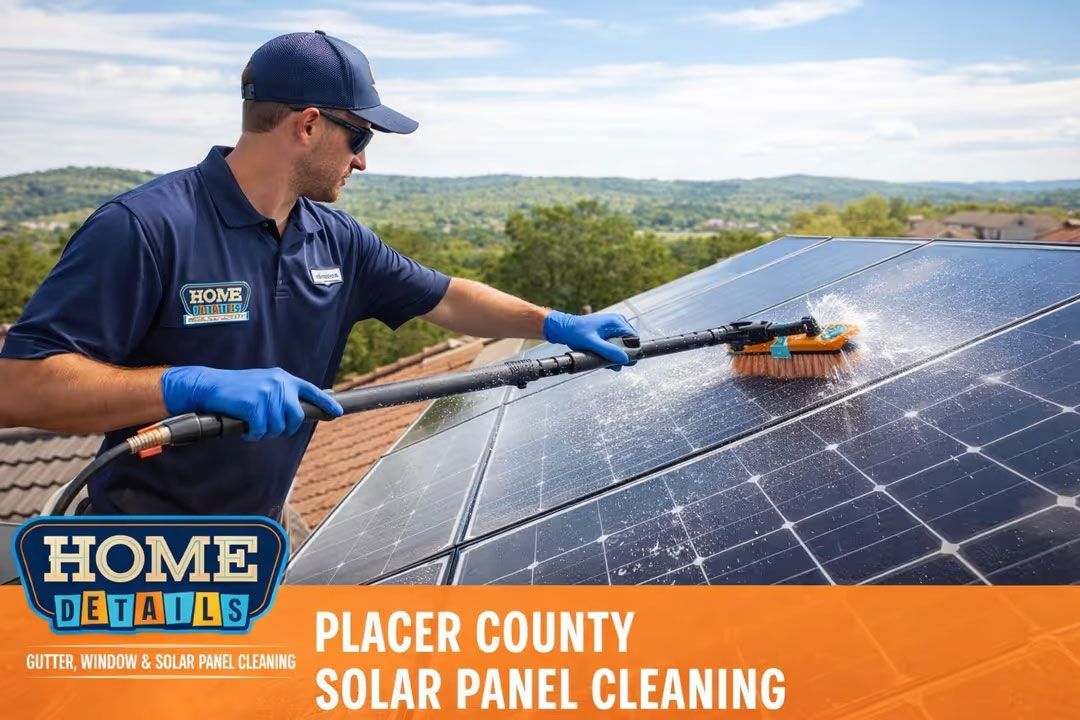
- Water-fed pole systems allow technicians to clean panels thoroughly while minimizing roof walking. This protects both the panels and the roof surface underneath.
- Soft brushes designed for solar glass remove stubborn residues—pollen films, bird droppings, baked-on debris—without scratching the protective coatings that help panels perform efficiently.
- Proper technique and angles ensure thorough cleaning without applying pressure that could stress panel frames or mounting hardware.
Professional crews also know how to work safely at roof level with proper harnesses, equipment, and training. That matters because falls remain among the most common serious household injuries, and climbing onto a roof while carrying equipment amplifies that risk substantially.
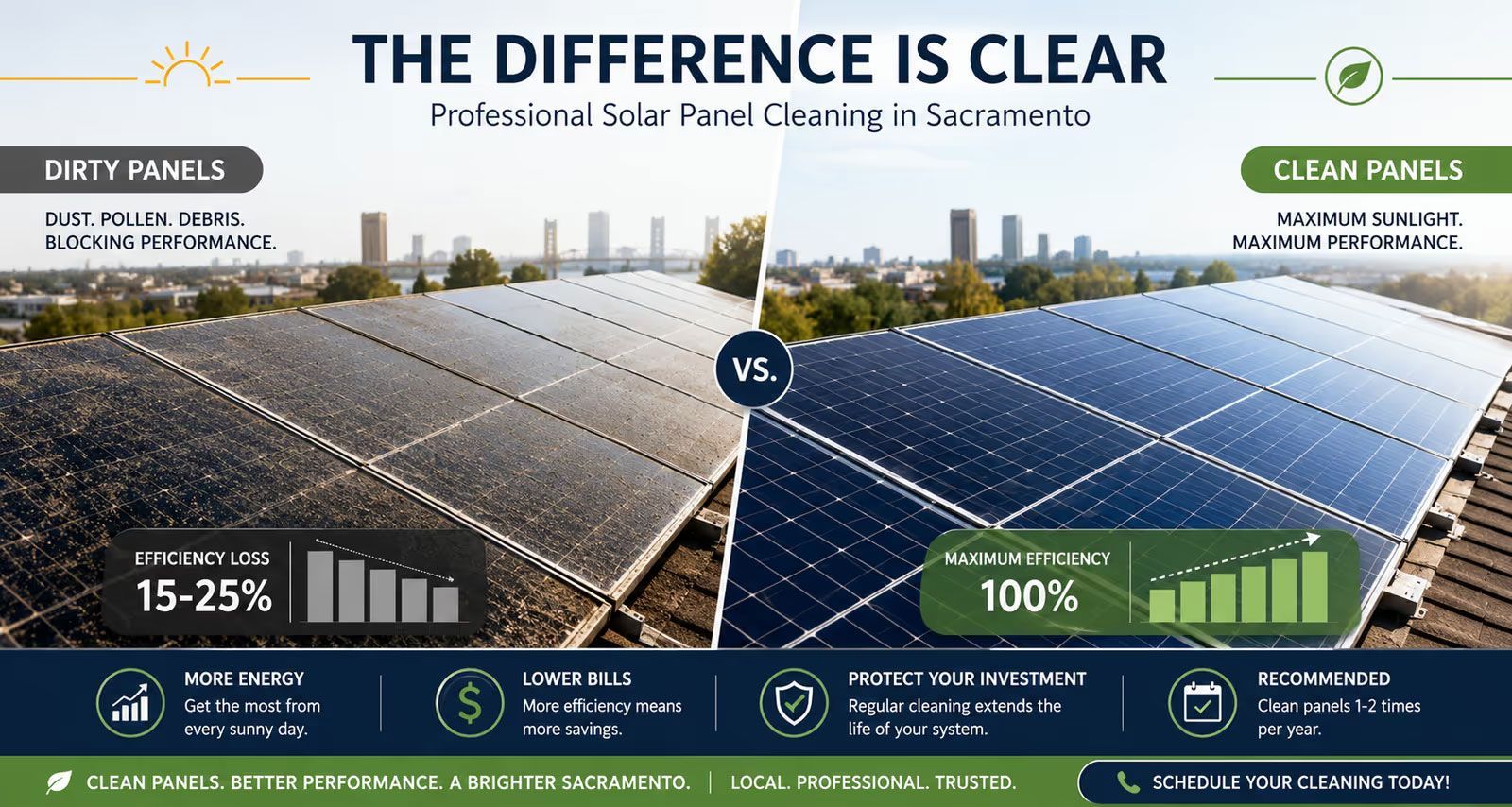
Solar panel cleaning in Sacramento can restore 5–15% lost production from soiling
Why DIY Cleaning Often Falls Short
Homeowners understandably wonder whether they can just spray panels with a garden hose. While light rinsing helps, it rarely addresses the actual soiling problem:
- Mineral deposits from hard water can leave residue that builds up over time, creating a film that reduces light transmission even on "clean" panels.
- Stubborn residues require proper techniques. Pollen films, bird droppings, and baked-on debris need appropriate cleaning solutions and soft brushes to remove without scratching protective coatings.
- Roof safety creates real danger. Walking on roof surfaces while carrying equipment isn't something most homeowners should attempt without proper training and safety gear.
- Panel damage is possible. Applying too much pressure, using abrasive materials, or stepping on panels can crack glass, damage frames, or void warranties.
The smarter approach? Leave the ladders to us and let trained professionals handle the hard-to-reach details safely.
Rising PG&E Rates Amplify Soiling Losses
California electricity customers face an uncomfortable reality: rates are climbing and show no signs of stabilizing.
PG&E has implemented multiple rate increases over recent years, and additional adjustments are approved or pending [. The more you pay per kilowatt-hour, the more valuable each kWh your panels produce becomes.
This creates an accelerating effect on soiling losses. If rates rise but your panels are still producing 5% less than they should, your effective loss grows without any change to your system.
Homeowners who maintain their panels consistently effectively hedge against rate increases by maximizing the free electricity they generate. Those who neglect maintenance find themselves increasingly dependent on grid power at whatever price PG&E sets.
In an environment of rising electricity costs, optimizing your solar production isn't just smart—it's financially protective.

Under NEM 3.0, solar panel cleaningin Sacramento maximizes valuable self-consumption
Warning Signs Your Panels Need Cleaning
Watch for these indicators that it's time for professional attention:
- Visible debris accumulation. If you can see dirt, bird droppings, or residue from ground level, your panels are overdue for attention.
- Production drops that don't match weather. Monitoring systems or your solar app can show when generation falls below expected levels for current conditions. A sudden or gradual decline during good weather often points to soiling.
- Higher PG&E bills than previous years. If your true-up amount keeps climbing despite no changes in household consumption, panel efficiency may be the culprit.
- Post-fire season residue. After wildfire smoke events, ash settles on outdoor surfaces including panels. Don't assume rain will handle it—smoke residue bonds to surfaces.
- Years since last cleaning. If you can't remember when (or if) your panels were professionally cleaned, they're almost certainly underperforming.
Many Sacramento homeowners schedule annual cleanings as part of routine home maintenance—similar to servicing HVAC systems or cleaning gutters before storm season.
Combining Solar Cleaning with Gutter and Window Maintenance
Since professional crews are already safely working at roof level for solar cleaning, many homeowners bundle related services to maximize value and convenience.
Gutter cleaning before fall storms protects your home from water damage while panels are being serviced nearby. Debris in gutters can actually blow onto panels during storms, so addressing both makes practical sense
.Window cleaning lets you enjoy clear views while your home's exterior gets comprehensive attention. Water-fed pole systems allow exterior windows to be cleaned safely from ground level.
Bundling services through a maintenance program means one scheduling call, one visit, and consistent professional care for your home's hard-to-reach areas throughout the year.
Schedule a Cleaning Before Peak Summer Production
Sacramento's solar production peaks during long summer days when sunshine is most abundant. Yet this is also when soiling accumulates fastest due to dry conditions, pollen, and dust.
Starting summer with clean panels means capturing maximum generation during the most productive months of the year. Waiting until fall means losing valuable kWh production during your highest-output season.
The best time to schedule professional solar panel cleaning in Sacramento is before months of accumulated grime steal more of your investment's value.
Ready to restore your system's full production and protect your PG&E savings? Get a free quote from Home Detail Services and see exactly how affordable professional solar panel cleaning can be for your Sacramento-area home. Leave the ladders to us.
Frequently Asked Questions
How often should I have my solar panels professionally cleaned in Sacramento?
Most Sacramento homeowners benefit from one to two professional cleanings annually. Spring cleaning removes pollen and winter debris before peak production season, while fall cleaning addresses dust accumulation and any wildfire residue before shorter winter days. Systems in dusty areas or near trees with heavy bird activity may need more frequent attention to maintain optimal output.
Will cleaning my solar panels void the manufacturer warranty?
Professional cleaning using appropriate methods and solutions should not void your warranty. However, improper cleaning—such as high-pressure washing, abrasive scrubbing, or harsh chemicals—can damage protective coatings and potentially void coverage. Reputable solar panel cleaning in Sacramento services use manufacturer-approved techniques specifically designed to clean without causing damage.
How much production can I realistically recover by cleaning dirty panels?
Recovery depends on how dirty your panels are, but most Sacramento homeowners see production improvements of 5–15% after professional cleaning. Research from NREL indicates typical soiling losses around 5% annually, though neglected systems or those in particularly dusty locations can experience significantly higher losses that cleaning can restore.
Does rain clean solar panels effectively?
Light rain helps but rarely provides thorough cleaning. Sacramento's dry summers mean panels go months without precipitation during peak production season. Even when rain does fall, it often lacks the volume and duration to remove stuck-on debris like bird droppings, pollen film, or mineral deposits. Rain can actually worsen appearance by creating streaky residue patterns as dust mixes with water and dries unevenly.
How does NEM 3.0 affect the value of keeping my panels clean?
NEM 3.0 significantly reduced the value of electricity exported to the grid, making self-consumption more important than ever. Since export credits are now worth less, every kilowatt-hour you lose to soiling is energy you'll need to purchase at full retail rates. Clean panels maximize the power available for direct use, improving your return on investment under the new billing structure.
About Home Detail Services
Home Detail Services has served Greater Sacramento homeowners for years, specializing in ladder-related home maintenance including solar panel cleaning, gutter cleaning, window cleaning, and Christmas light installation. Our trained, insured professionals use safe techniques and appropriate equipment to protect both your home and your investment. We understand Sacramento's unique climate challenges—from Central Valley dust to wildfire smoke seasons—and help local homeowners maintain their properties without the risks of climbing ladders themselves. Our commitment to quality service and customer satisfaction has made us a trusted choice for residential maintenance throughout the region, from Elk Grove to Auburn and everywhere in between.
Cited Works
[1] National Renewable Energy Laboratory — "Photovoltaic System Soiling." https://www.nrel.gov/pv/soiling.html
[3] Pacific Gas & Electric Company — "Understanding Your Electric Rates." https://www.pge.com/en/account/rate-plans/how-rates-work.html
[4] California Public Utilities Commission — "Net Energy Metering." https://www.cpuc.ca.gov/industries-and-topics/electrical-energy/demand-side-management/net-energy-metering
[5] California Solar & Storage Association — "NEM 3.0 Overview." https://calssa.org/nem-3
[6] Home Detail Services — "Solar Panel Cleaning in Services." https://homedetailservices.com/solar-panel-cleaning/